

Image credit: University of Cambridge.
The PIXEurope project is an ambitious European effort to accelerate the adoption of integrated photonics, tiny, light-based circuits poised to transform everything from data communications to artificial intelligence. By bringing together leading research institutions, foundries and technology developers, PIXEurope aims to overcome some of the field’s most persistent barriers: high production costs, lack of standardisation and limited access for startups and small-scale innovators.
As Dr Stefano Signorini, who leads technical research in hybrid photonics at The Institute of Photonic Sciences (ICFO), explains, the project is designed to function “like a virtual institute,” covering the full innovation pipeline from design and fabrication to packaging and testing. “The idea is to gather some of the main players in Europe related to integrated photonics,” he says, “and find together a solution to these problems.”
Among those problems are the high costs of scaling up photonic devices – particularly in packaging and testing, which can account for up to 80% of total costs – and the fragmented nature of current manufacturing processes. PIXEurope aims to address these through shared standards and coordinated infrastructure, making photonics more accessible and commercially viable.
A focused workshop on hybrid photonics
On 22–23 April 2026, representatives from ICFO, the University of Cambridge and the University of Southampton gathered at the Cambridge Graphene Centre for a two-day workshop under the PIXEurope umbrella. The focus: hybrid photonics, and specifically the integration of graphene and other two-dimensional materials into photonic chips.
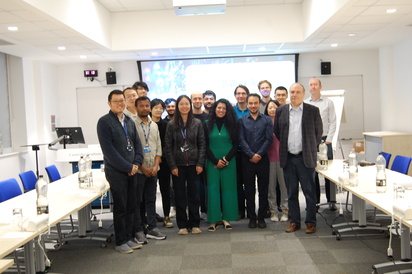
Image credit: University of Cambridge
“The idea of this workshop is actually to sit together and understand how collectively we can address the needs in how to integrate graphene on chips efficiently,” says Signorini. Each partner brings a distinct strength, Southampton’s photonic foundry capabilities, Cambridge’s expertise in graphene and ICFO’s advanced research in photonics and materials.
Dr Emre Kaplan, process design kit manager at CORNERSTONE and senior enterprise fellow at the University of Southampton, highlights the collaborative nature of the effort. “We’ve come together – designers, process engineers, managers – with the aim of working out how we can develop this synchronised collaboration within PIXEurope for the long term,” he says.
Tackling technical challenges and finding opportunity
A central focus of the workshop has been confronting the practical challenges of turning cutting-edge research into manufacturable technology. Rather than abstract discussion, participants have worked to pinpoint shared technical barriers and align their approaches across institutions.
“We really came together to find common technical problems, how we can address them and decide what our approaches should be,” says Kaplan. By bringing together designers, engineers and researchers in one room, the group has been able to move quickly from discussion to action. “We actually created some ideas to test already on the first day… and then on the second day we will continue to bring more ideas to find solutions.”
For Signorini, what stands out is not just the challenges themselves, but the clarity they bring. “There are still problems, and that’s interesting,” he says. “When you do photonics… you always have a trade-off. But when you can see it clearly, and maybe find a way to remove it, then you are really making a breakthrough.”
That sense of being on the edge of something transformative is reinforced by the technical progress already visible. Reflecting on the work presented at Cambridge, Signorini notes: “I saw some results that I didn’t know about… I’m quite impressed. I see that there is a concrete opportunity for graphene chips.”
Together, these insights point to a field still in development, but rapidly maturing—where identifying the right problems may be just as important as solving them.
Building momentum for the future
Beyond immediate technical outcomes, the workshop demonstrates the value of close, in-person collaboration within large-scale projects. “You really boost your progress within a short time,” Kaplan reflects. “It is amazing to come here, exchange the knowledge, and then make a common plan.”
As PIXEurope continues, such focused collaborations are likely to play a crucial role in turning promising research into scalable, real-world technologies. Bringing integrated photonics closer to widespread adoption.
By Dr Karen Steward