

Image credit: University of Cambridge.
A cohort of 12 doctoral students from the UK’s flagship Centre for Doctoral Training in 2D Materials of Tomorrow (2DMoT) are spending 10 days at the Cambridge Graphene Centre (CGC), gaining hands-on experience with advanced characterisation techniques and exploring new directions in graphene and related technologies.
The students began their training at The University of Manchester with a six-month intensive programme designed to prepare them for cutting-edge research in two-dimensional materials; ultra-thin substances with applications ranging from clean energy to quantum devices. Their visit to the University of Cambridge offers a rare opportunity to engage directly with world-leading facilities and researchers before beginning their PhD projects.
From theory to real-world applications
For many, the visit represents a shift from broad training into more focused research ambitions. Agustin Montemurro, who previously studied theoretical physics, commented: “I have since moved towards condensed matter… motivated by the opportunity to apply similar frameworks to systems with more direct technological relevance.” During his time in Cambridge, he hopes “to learn about the theory and applications of Raman spectroscopy and to model optoelectronic devices.”
Others arrive with strong experimental or industrial backgrounds. Heloise Grandjouan, who worked with a clean-tech startup before returning to academia, is now researching sustainable battery materials. She emphasised the value of the Cambridge environment, noting the group has been “welcomed into Cambridge’s impressive facilities… where I look forward to learning more about the photon and optoelectronic research capabilities.”
Interdisciplinary training at the core
Across the cohort, a common theme is the desire to bridge disciplines. Harriet Stoner highlighted the appeal of combining chemistry and physics, saying “I really enjoyed the interdisciplinary nature of my degree,” and is now keen to apply that perspective to graphene research. Similarly, Helena Amos, whose background spans both subjects, said she is “particularly interested in energy applications and green technologies” and is eager to gain experience in unfamiliar techniques.
The training programme at Cambridge places particular emphasis on advanced characterisation methods such as Raman spectroscopy, as well as emerging areas like photonics and high-frequency electronics. For Sunandan Panda, whose research focuses on memristors for neuromorphic computing, these topics are directly relevant: “I look forward to exploring the applications of 2D materials in photodetectors and optoelectronic devices… which will directly support my PhD research.”
Bridging academia and industry
Several students also highlighted the importance of understanding how fundamental science translates into real-world applications. Adam Rosillo, who previously worked in the semiconductor industry, is focused on bridging that gap. He is “excited about bringing graphene-based products closer to industrialisation,” drawing on both his industrial and teaching experience to shape his research approach.
For others, the visit plays a role in shaping major academic decisions. Albert Coomber, who has not yet selected his PhD project, hopes the experience will help him decide which research project to choose, while Patrick Knowles sees it as a chance to broaden his perspective: “I would like to understand what other institutions are studying… what equipment and capabilities they have, and what research directions they are exploring.”
Building a research community
Alongside technical training, the visit also fosters collaboration and cohort-building. Many students mentioned the value of networking and informal interaction. Angela Gupta described the week as “a lovely chance to spend more time with my wonderful cohort and explore a new city together,” while Panda noted his excitement about “connecting with researchers across the programme.”
The cohort itself reflects the diversity of pathways into modern materials science. Some students come directly from undergraduate or master’s degrees, while others have spent years in industry or education before returning to research. Ellis Huntley, for example, has already contributed to theoretical work on graphene and is now preparing to investigate quantum phenomena experimentally, with a paper currently in preparation.
A stepping stone to independent research
By the end of the visit, 2 students will remain in Cambridge to continue their PhDs, while the remaining 10 will return to Manchester. Yet the shared experience underscores the collaborative nature of the CDT model, which integrates training across institutions and disciplines.
As the field of 2D materials continues to evolve, initiatives like 2DMoT aim to equip researchers not only with technical expertise, but also with the adaptability to tackle complex, interdisciplinary challenges. For this cohort, the Cambridge visit marks an important step in that journey, from foundational training towards independent, impactful research.
Meet the students
Adam Rosillo
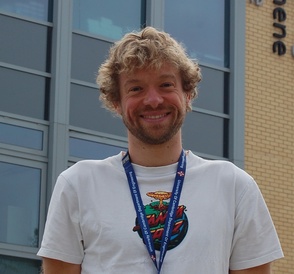
After studying my undergraduate physics degree at The University of Manchester, I spent four years working at Nexperia UK in the semiconductor industry. There, I worked on product development, process integration and process engineering. Following this, I worked as a science teacher in secondary schools around Manchester. This experience helped me refine my communication skills, explaining complex ideas in an easy-to-understand manner. My PhD project will be on suspended 2D heterostructure membranes and devices based at the National Graphene Institute in Manchester. I am excited about bringing graphene-based products closer to industrialisation.
Agustin Montemurro
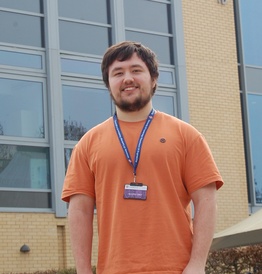
I completed an integrated MPhys in theoretical physics at the University of Liverpool, where I focused on quantum theory and string theory with a broader interest in theoretical physics, including solid state physics. Last year, I completed a year abroad after finishing my masters in Suzhou, China, which was an amazing experience. I have since moved towards condensed matter, joining the 2DMoT CDT, motivated by the opportunity to apply similar frameworks to systems with more direct technological relevance. At the University of Manchester, for my PhD project, I will be joining Vladimir Falko’s group to work on nonlinear transport in moiré structures.
Albert Coomber
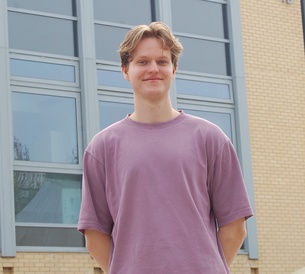
I completed a four-year MChem at the University of Oxford with a masters in electrochemical biosensing and really enjoyed the research experience during my final year, so decided to go straight into a PhD. I chose the 2DMoT to continue learning more theoretical frameworks and experimental techniques before starting my research project.
Angela Gupta
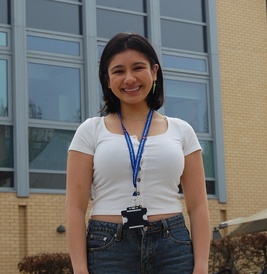
I did an integrated masters in chemistry and physics at the University of St Andrews. My master's project was on developing catalyst supports for heterogeneous catalysis. I will be doing my PhD in Manchester, in Prof. Andre Geim's group. My research will broadly be focused on conducting electron transport measurements at low temperatures and high magnetic fields on graphene-based devices, and exploring quantum phenomena such as the fractional quantum hall effect. The CDT has been an incredible opportunity to learn about the fundamentals and applications of 2D materials and getting hands-on experience in fabricating devices.
Ellis Huntley
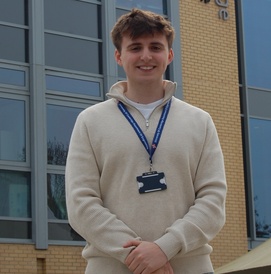
I completed a four-year MPhys at The University of Manchester, with my masters project in theoretical work on dimensional crossover in superconductivity. I joined the 2DMoT programme to gain experimental experience alongside further theoretical development. During the training phase, I worked on a project on non-trivial topological electron states in ABA graphene, with a paper currently in preparation. I will be joining Prof. Andre Geim’s group to study the visualisation of quantum phenomena in ultra-high-mobility graphene using scanning electron microscopy.
Harriet Stoner
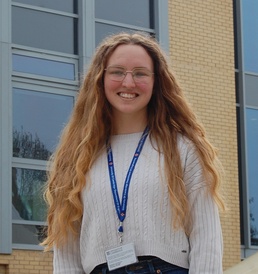
My first degree was an integrated masters in natural sciences (chemistry with physics) in Bath, with my final year project in utilising lipid self-assembly to template polymer nanostructures. I really enjoyed the interdisciplinary nature of my degree, learning about materials from both a physics and chemistry angle. After graduating I worked for a few months in a PVC foil factory and while I valued the industrial experience, I realised I wanted to go back into academic research. So far, the training programme on the CDT has taught me lots about 2D materials and their properties, and I look forward to starting my project with Dr. Alex Walton in Manchester on using graphene as a window for operando XPS of catalytic processes, putting my knowledge to a practical use.
Helena Amos
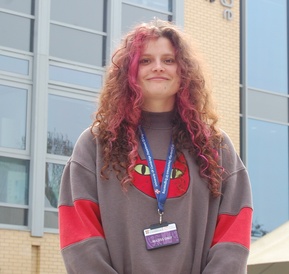
I did my bachelor's and master’s at Nottingham University in natural sciences (50:50 split of physics and chemistry). My project is at The University of Manchester looking at field effects for ion selectivity in 2D materials with Dr. Marcello Lozada Higalo. I am particularly interested in energy applications and green technologies.
Heloise Grandjouan
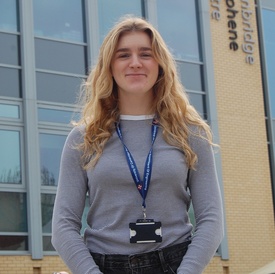
After studying chemistry at The University of Manchester, I did my master’s on nanoscience in Cinzia Casiraghi’s group on graphene-based thin-film thermoelectric devices. I then joined a startup, Watercycle Technologies, in its early stages to develop and scale sustainable technologies for mineral extraction from waste streams and end-of-life batteries. Watercycle became an industrial partner on the 2DMoT CDT, enabling them to fund a PhD project. This has allowed me to continue research connected to Watercycle at The University of Manchester, with co-supervisors Sarah Haigh and Mark Bissett, on 2D-coatings for enhancing the performance of recycled battery materials.
Lucy Kendall
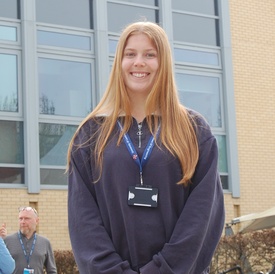
I studied physics at The University of Sheffield as well as completing my master’s there. My background is quite broad as I never specialised, but deciding to do my PhD and be a part of the 2DMoT CDT, I have moved to condensed matter and material physics. I have always been interested in the energy transition, and this helped me choose my project, which is understanding ion-intercalation as the fundamental process underpinning the operation of rechargeable batteries.
Oktay Deveci
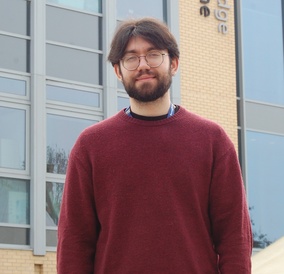
I did my undergraduate degree at The University of Manchester in physics, which had its up and downs, but meant I had the opportunity to do my masters project working with graphene, which I enjoyed a lot. I then spent a year after graduating working at a school but was very eager to return to academia and start my PhD. From this week I’m hoping to start familiarising myself with Cambridge, not just with the work going on here but the people and the city itself, and I hope this can function as a nice transitional period before I start my project here. I’m very excited to start my project and to hopefully start applying some of what I’ve learnt the past six months in Manchester.
Patrick Knowles
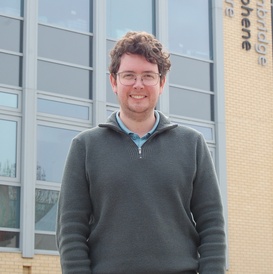
I did my bachelors and master’s degree in physics at the University of Bristol. My master’s project was studying electrical conductivity at low temperatures of layered materials. After graduating, I worked in a fibreoptic research company in Oxfordshire, working on a fibreoptic fuel level sensor for commercial aircraft. After several years, I wanted to get into research to develop the independent working and critical analysis skills as well as study something new and explore the unknown. My PhD project at Manchester will be on tuneable graphene-based devices for space applications with Prof. Coskun Kocabas.
Sunandan Panda
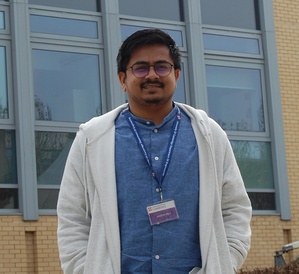
I completed both my undergraduate and Master’s studies at NISER Bhubaneswar, India, earning an Integrated MSc in physics. For my Master’s thesis, I worked on ferroelectric field‑effect transistors, exploring their potential for introductory brain‑inspired neuromorphic computing. For my PhD, I will be focusing on printed memristors based on 2D materials, with an emphasis on ECM‑based resistive switching, precise dielectric engineering and simulations of their performance within neural network architectures. I am delighted to be working under the supervision of Prof. Cinzia Casiraghi.
By Dr Karen Steward