

Image credit: KP Yamu Jayanath on Pixabay.
The Cambridge Graphene Centre (CGC) hosted an international delegation of industry and research leaders working at the forefront of graphene commercialisation. The visit brought together representatives from Korea, Germany and the UK, reflecting the increasingly global ecosystem around two-dimensional (2D) materials.
The delegation included Patrick Frantz of Pterons, Marius Restle from the German base of JX Advanced Metals Corporation, Hee Jin Jeong of the Korea Electrotechnology Research Institute (KERI), and Yun Su Choi from the Korea Carbon and Nano Industry Association (KCANIA) (pictured below).
During their visit, the group delivered short presentations to CGC researchers, met with academic and technical staff and toured the Centre’s facilities.
Building international bridges in graphene innovation
Patrick Frantz, a long-standing collaborator of CGC through his earlier work supplying synthesis systems for 2D materials growth, now focuses on the commercial side of graphene through his consultancy Pterons. His current mission is to help international partners forge meaningful relationships in the UK graphene landscape.
“This trip is mostly about helping our partners build connections around graphene in the UK,” he explained. “The CGC is of critical importance, both for its position in the UK and its links across Europe.”
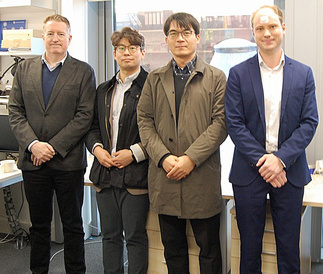
From left to right, Patrick Frantz, Marius Restle, Hee Jin Jeong and Yun Su Choi during their visit to CGC. Image credit: University of Cambridge.
For companies and institutes seeking to move beyond early-stage research, institutions like CGC offer a vital bridge between laboratory-scale breakthroughs and scalable applications. The Centre’s combination of fundamental science, device integration expertise and industry engagement makes it a strategic partner for organisations aiming to accelerate technology readiness.
From substrates to devices: Supporting the graphene value chain
The delegation represented multiple points along the graphene value chain, from materials supply to applied device development.
JX Advanced Metals, a major Japanese copper foil manufacturer, is expanding its European footprint. Its high-quality copper foils are used as substrates for chemical vapour deposition (CVD) graphene growth, a key enabler for producing large-area, high-quality graphene films.
“When it comes to Europe, graphene research is centred in Germany and the UK, and in the UK, Manchester and Cambridge,” said Marius Restle, Business Development Manager at JX Advanced Metals. “Institutions like CGC are unique and critical for us to engage with, especially when we are supplying base materials that underpin graphene growth.”
Meanwhile, researchers at KERI are focused on applied carbon nanomaterials and graphene for electronic devices, with an emphasis on technologies approaching commercialisation (technology readiness levels 4–5 and above). Their work includes conductive inks based on graphene and related materials, targeting near-term industrial uptake.
“We are concentrating not just on basic science, but on technologies that can be directly transferred to companies,” explained Hee Jin Jeong. “We are interested in collaboration between the UK and Korea in these application areas.”
KCANIA plays a coordinating role across the Korean carbon and nanomaterials industry, helping to stimulate international collaboration and industrial exchange. Recent initiatives have included facilitating memoranda of understanding between Korean nanomaterial producers and UK-based technology companies, with the aim of replicating similar activities involving CGC and its spin-outs.
A strategic node in the global graphene network
The visit also laid the groundwork for future engagement, including potential participation from CGC leadership in international industry events hosted by KCANIA.
For the delegation, connecting with CGC was a strategic priority. Its integration within the UK research landscape, combined with strong links into European graphene initiatives, positions the Centre as a top-tier hub for collaboration.
As graphene technologies continue their transition from laboratory research to industrial deployment, international partnerships are increasingly essential. By convening expertise across materials supply, device engineering and commercial strategy, visits such as this reinforce CGC’s role as a global node in the graphene innovation network.
The Centre looks forward to deepening these relationships and exploring new avenues for UK–Asia collaboration in advanced carbon materials.
By Dr Karen Steward